
Flower Field Guide
Tanacetum parthenium · Asteraceae
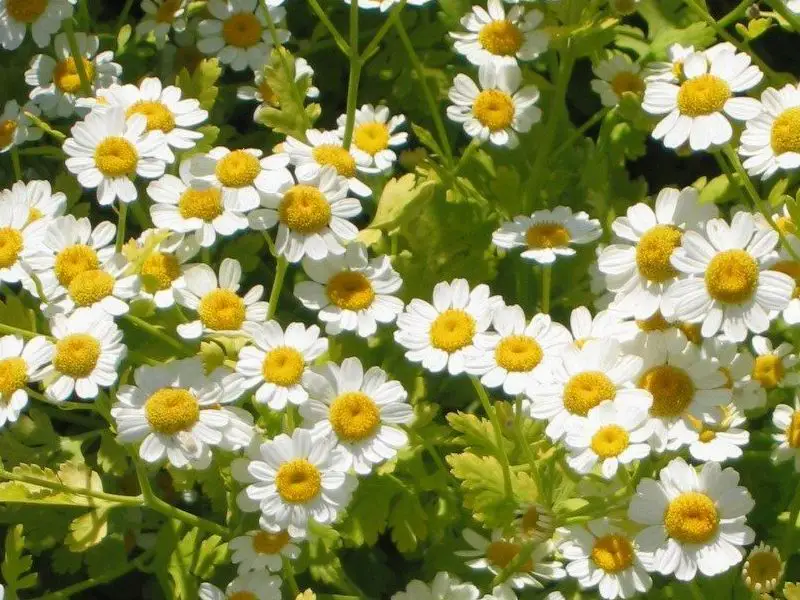
Photo: Vsion, CC BY 2.5, via Wikimedia Commons
✿
Best in Santa Barbara County
Late spring through summer, often into fall
Family
Asteraceae (the daisy family)
Native to
The Balkans in southeastern Europe
Plant type
Herbaceous perennial that forms a small bush
At our farm
‘Magic Lime Green’
‘Magic Single’
‘Sunny Ball’
‘Tetra White’
‘Virgo’
Feverfew is a small, bushy plant in the daisy family that grows up to about 28 inches tall. Its classic flowers look like mini daisies, with white petals around a yellow center, each one less than an inch across. Some of our varieties have extra petals that make them look more like tiny pom-poms. The leaves are light yellow-green and have a strong smell when you brush against them. The name probably comes from "featherfew," after the plant's feathery leaves.
Feverfew is a perennial, so it can come back year after year. It usually starts flowering in late spring and keeps blooming through summer, and in mild places it often keeps going into fall. It also spreads quickly by dropping seeds, so new plants pop up on their own.
In the wild, feverfew grows on stony slopes and in rocky riverbeds, so it's used to soil that drains fast and summers that are pretty dry. That's a lot like the hillsides along the Gaviota Coast. It doesn't need much babying, and our mild winters mean the plants don't get knocked back by hard freezes.
Feverfew has been written about for a really long time. The Greek physician Dioscorides described it in the first century, and a text by Hippocrates mentioned it way back in the 4th century BCE. People used it as a folk medicine for centuries, but modern studies haven't found clinical evidence that it actually treats anything.
Want to see it in person? Come cut your own at Harris Gaviota Farm. Check what's blooming on our You-Pick availability sheet.
Source: adapted from the Wikipedia article "Tanacetum parthenium" (CC BY-SA 4.0).
