
Flower Field Guide
Zinnia (genus) · Asteraceae
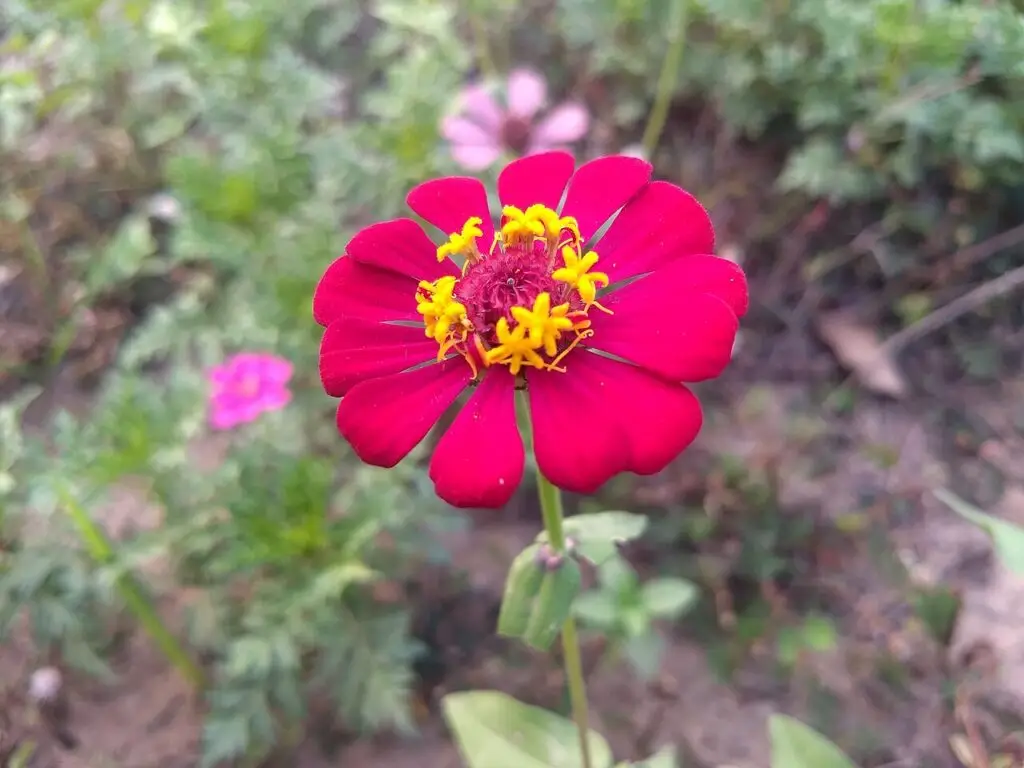
Photo: শক্তিশেল (Shaktishel), CC BY-SA 4.0, via Wikimedia Commons
✿
Best in Santa Barbara County
Summer through fall
Family
Asteraceae (the daisy family)
Native to
Southwestern United States to South America, mostly Mexico
Plant type
Annual (some species are shrubs)
At our farm
‘Agave’
‘Benary's Giant Lime’
‘Benary's Giant White’
‘Linen’
‘Queeny Formula Mix’
Zinnias are bright, cheerful flowers in the daisy family, known for long stems and blooms in just about every bold color. They come in a few main forms: "single" zinnias with one row of petals and a visible center, "double" zinnias with so many rows you can't see the center, and "semi-double" ones in between. They're named after Johann Gottfried Zinn, an 18th-century German scientist who collected zinnia seeds in Mexico. Since breeders started working on them in the 1800s, more than 100 varieties have been created.
Zinnias are annuals that are usually planted straight into the ground from seed, because their roots are fragile and they don't love being transplanted. They bloom all summer and into fall. The best part for a you-pick farm is that the more you cut them, the more flowers the plant makes.
Wild zinnias grow in scrub and dry grasslands from the Southwest US down through Mexico, so heat and sun are their thing. They handle hot summer temperatures easily and grow best in full sun with well-drained soil. Our warm, sunny summers on the Gaviota Coast give them exactly what they need to bloom like crazy.
Zinnias went to space. They were the first plants grown in a formal NASA experiment using the Veggie plant-growth system on the International Space Station, which helped scientists learn how to grow flowering crops in microgravity.
Want to see it in person? Come cut your own at Harris Gaviota Farm. Check what's blooming on our You-Pick availability sheet.
Source: adapted from the Wikipedia article "Zinnia" (CC BY-SA 4.0).
